

Paleo Culture in Augusta County, VA
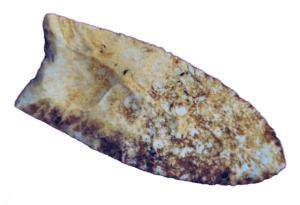
(All of the artifact shown are from the Woodland Culture and were found in Augusta County, VA)
There are no period documents that tell us when the first people inhabited Augusta County. To answer that question, research has focused on the dating of artifacts found in the region.
After extensive study, archaeologists agree that the first humans in Augusta County were the Native American people called Indians. (Indian: the name given by early explorers to Native Americans because they thought they had found India.)
Archaeologists agree that the Native American Cultures matured over a period of more than 15,000 years and experienced varying cultural change.
The study of these diverse cultures prompted researchers to identify and name the four periods of Native American culture as the Paleo Culture, the Archaic Culture, the Woodland Culture, and the Mississippian Culture.
The first people to inhabit Augusta County were the Paleo Native Americans. Archaeologists have labeled a period from pre-15,000 BC to 8,000 BC as the Paleo Culture. The prefix “paleo” comes from the Greek adjective palaios, meaning “old”.
During the Ice Age, Augusta County, Virginia, was believed to have experienced a very cold and damp climate from the effects of the frozen area to the immediate north. Much of the northern world was frozen and there were solid ice formations that connected North America to Asia from the West Coast and to Europe from the East Coast. There are two theories as to how the Paleo people arrived in eastern Virginia.
The first theory suggests that these very early nomadic people came across the Bering Strait from Siberia (Asia) and migrated east to Virginia.
The second theory suggests that some of the early Paleo Culture arrived first in Eastern Virginia, and then traveled west into Augusta County from Europe. It is also plausible that both theories are correct and the Paleo people reached America across frozen waters, each from Asia and from Europe.
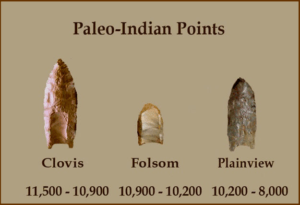
Much of the study of the origin of the Paleo Culture is centered around an artifact from the Paleo Culture known as a Clovis Point. This theory suggests that the origin of the Clovis Point is from the European Culture and is known as the Solutrean Hypothesis. According to the Solutrean Hypothesis, during the Ice Age people of Europe migrated to North America, perhaps using skin boats hunting for food.
They brought their methods of making stone tools with them, thus providing the basis for the Clovis Technology that quickly spread throughout North America, including Augusta County.
The Paleo hypothesis is based on the proposed similarities between European Solutrean and early American pre-Clovis and Clovis lithic (stone) technologies. Proponents of the Solutrean Hypothesis also point to the Cinmar blade as evidence that supports the Solutrean Hypothesis.
The Cinmar blade was removed from a mammal found off the coast of Virginia. The blade carbon dates to 22,000 BC. The Cinmar blade was named after the boat that found the point in mammal bone fragments while dredging off the coast of Virginia in the 1970’s. This blade is very similar to the blades found in the Solutrean Culture in Europe but absent in the Asian Culture.
Supporters of the Solutrean Hypothesis also refer to archaeological finds of the Clovis Point in Virginia as evidence of the Paleo people throughout Virginia.
The Paleo people were nomadic people that hunted large and small herbivorous mammals (plant eaters). Small isolated groups of hunter-gatherers migrated alongside herds of large herbivores (plant eating mammals). Stone and wood tools, particularly spears with Clovis projectiles were used to gather food. By 9,000 BC these large mammoths were extinct. Smaller mammals and plants became the only source of food. Diets were often rich in protein due to successful hunting. Clothing and shelters were made from a variety of animal hides. Regardless of the origin of the Paleo people, their culture was the basis from which future Native American cultures developed. Between 8,000-7,000 BC a warmer climate stabilized, leading to the rise in animal life, vegetation, and human population which lead to lithic (stone) technology advances. The result was the Archaic Culture with a semi-sedentary lifestyle.
Paged developed by Gordon Barlow gordon@amaty.com