



Augusta County 21st Century
Early in 2000 Augusta County officials with input from the private sector adopted an economic strategy that advance the work that was done during the 20th century. The strategy focused on Augusta Counties assets.
Land Use
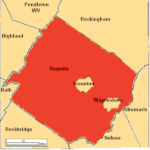
Augusta County has approximately 620,000 acres of land, 35% of which is public land (predominantly national parks and forests), and 34% is in agricultural use. Less than 1% of the land area in the County is in commercial and industrial use. The County’s Comprehensive Plan designates 9,586 acres, including the land already developed for such purposes, for future commercial and industrial use. The majority of the future employment growth and most
industrial development will occur in designated Urban Service Areas, which cover about 7% of the total acreage. Relative to other land uses in Augusta County, the amount allocated for economic development represents a small portion of the total land area.
Local Economy
The Augusta County economy is fairly diverse, with manufacturing, transportation and warehousing, health care, agriculture, government, hospitality and tourism, and retail among its largest components. While there are more than a dozen manufacturing operations with 100 or more employees, the County has not added any major manufacturers to the mix since the early
1990s. There is also a growing array of small businesses that represent diverse segments of the local economy.
Understanding product and business life cycles is important in appreciating the dynamics of the economy. Although livestock, dairy and poultry have been the principal focus of local agriculture for many years, the farm product mix has experienced significant changes since 1900. For example, County farmers produced nearly two million bushels of apples as recently as the 1940s, and today, the apple industry accounts for only a small proportion of agricultural
sales. The manufacturing sector has also under gone shifts, from predominantly locally-owned businesses to nationally and even internationally owned firms that have capitalized on the geographic positioning of the area to serve key East Coast markets.
Business Survey
An online business survey targeted specifically to major employers in the area yielded a total of 32 responses, 28 of which came from businesses physically located in Augusta County. The survey found that the revenues of most Augusta County businesses have increased over the past two years, in some cases by more than ten percent. In addition, four out of five respondents said that they anticipate some type of growth or expansion in the near future.
Plans include hiring additional employees, renovate or expand their facilities, and/or leasing additional space in the County. Very few businesses indicated that they are thinking about leaving the County.
Asked about their level of satisfaction with various aspects of the local business climate, respondents are most satisfied with the quality of life, cost of living, and access to capital in Augusta County. The location, interstate highway access, people, and schools are also highly valued by businesses, according to the survey. Respondents are less satisfied, however, with the costs of land and commercial space, energy costs, and the responsiveness of local government to business needs. The concerns of businesses regarding the responsiveness of local government may be based on specific experiences, but could also reflect perceptions based on what individuals hear from colleagues or read about in the local press. Although businesses believe that the quality and productivity of
labor are generally very good, they expressed concerns about the availability of labor, noting the difficulties they have had recruiting workers, particularly those with specific technical skills. In identifying potential economic development policies or initiatives for the County to pursue, respondents are most supportive of improving the availability of broadband Internet access, addressing labor force issues through education and training, assisting farmers in diversifying and growing their businesses, and establishing a new economic development organization with private sector representation.
The project team conducted a series of in-depth interviews with local employers and other stakeholders, including the Shenandoah Valley Partnership, economic development officials in Staunton and Waynesboro, real estate professionals, and educators and work force development staff. The employer interviews were generally structured around labor requirements, company needs, and the advantages to and challenges of doing business in
Augusta County, while stakeholders were asked for their opinions regarding the County’s current approach to economic development and potential opportunities. The message from local employers was consistent with the survey results with regard to obtaining qualified skilled labor in the quantities needed to support business growth. Employers are concerned about the area’s low unemployment rates and the limited supply of qualified new recruits, as well as the lack of interest among young people in manufacturing positions. Several employers noted that housing affordability (i.e., homes of less than $250,000) further impacts their ability to attract labor from outside the region. Interviews also revealed that relationships bet ween local employers and County officials vary
considerably. While some employers characterized the County as extremely supportive and helpful, others found the County’s development review process to be cumbersome.
Perhaps the best strategy for Augusta County was their commitment to an economic development programs that include business retention and expansion, business recruitment, financial incentive programs, marketing, and site selection assistance.
Additional history needs to be developed – Volunteer(s) needed.
Contact Gordon Barlow gordon@amaty.com 540-448-0344