
Ice Age
More than 15,000 years ago, during a period that archaeologists define as the Ice Age, humans appeared in Eastern North America including present day Augusta County. The later stage of the Ice Age is known as the Pleistocene Period, and lasted until about 11,000 years ago. The name Pleistocene is the combination of two Greek words: pleistos (“most”) and kainos (“new” or “recent”).
This period was the most recent component of the Ice Age which began more than 1.8 million years ago.
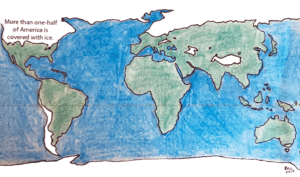
Augusta County was believed to be on the southern edge of the Ice Age formation in North America thus became a migration area for animals and humans. At one point during the Ice Age, sheets of ice covered large parts of Europe and North America. Scientists have cautiously defined the Pleistocene Period because of the lack of firm evidence.
However, through carbon dating of objects, scientists believed the Pleistocene Period to be the first period in which Homo Sapiens evolved. Humans are believed to have occupied every part of our planet.
Exactly when the Homo Sapiens came to Augusta County is not known for certain, but carbon dated artifacts place their existence in Augusta County more than 15,000 years ago. The Ice Age climate was much colder and drier than is the climate today.
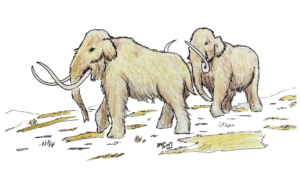
Large mammals became extinct during the Ice Age. Scientists are not sure exactly why. Many small mammals survived the Ice Age and multiplied to become a source of food. These mammals included cow, deer, rabbits, bears, and members of the canine and feline families. Birds including ducks, geese, hawks, and eagles flourished during this period. Lizards, turtles, pythons, and other reptiles increased in population during the late Ice Age.
Vegetation was fairly limited during the early Ice Age, but that changed by 11,000 BC with the growth of pine, beech, oak, and yews. On the ground, prairie grasses, small berry plants, and flowers thrived. By 10,000 BC, the Ice Age had disappeared from North America and the Paleo Native Americans were hunting smaller mammals and gathering food in a sustainable climate in Augusta County.
Page developed by Gordon Barlow gordon@amaty.com