Militia in Augusta County, VA
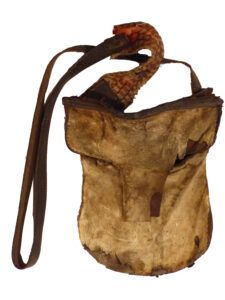
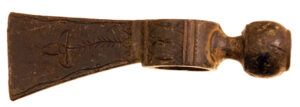
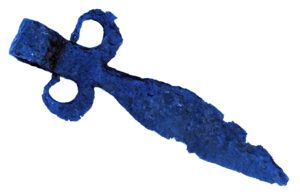
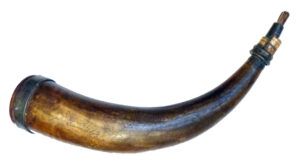
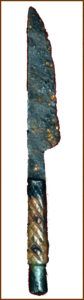
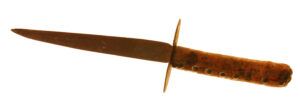
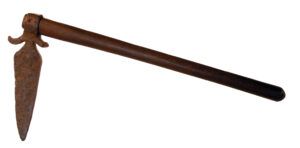
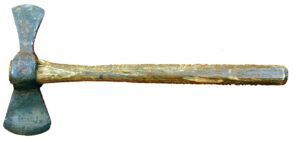
All artifact shown were found in 18th century Augusta County, VA
Hostilities on the frontier required the development of a strong militia that was well equipped, and ready to meet the challenges of the Native American attacks. The colonial government wanted settlement in Augusta County and recognized that organizing a standing militia was the only way to meet that challenge. They also recognized that the laws prior to 1738 on governing the Virginia Militia were not adequate. On November 12th, 1738, the Council adopted an act to better assemble and regulate the militia.
Developing a standing militia in Augusta County was a welcome approach to providing safety on the frontier. The leadership for a more formal militia was in place, and militiamen had grown to respect leaders who they had basically appointed. The challenge of maintaining a formal militia evolved primarily around two important issues: accoutrements and discipline.
The Augusta County Militia Companies grew into a formidable defense against the Native Americans. They developed safe havens for their personal safety. Hundreds of these well-fortified safe havens, often with a water supply, existed throughout the Augusta County.
One well known example of such a structure is the safe house built on the south side of Middle River near Churchville, Virginia, that is known as the “Old Fort – Keller House”. The tenacity and abilities of the Augusta County Militia was well-known throughout frontier. The Augusta County Longrifle Militiamen gained notoriety throughout the 18th century as they were very active in protecting the frontier settlers and settlements from Native Americans, in both the French and Indian War and the Revolutionary War.
Augusta County Gun Factory
Longrifles, muskets and fusils for the Augusta County Militia was in high demand. After the French and Indian War, Jacob Gabbott, who had apprenticed to Christopher Heskill in Winchester, Virginia arrived in Staunton, Virginia. He was joined by Alexander Simpson in 1764, and later by Joshua Perry and Joshua Humphreys.
Together these “smiths” (with gunsmiths, brass-smith, white-smith and blacksmiths skills) opened the Augusta County Gun Factory in Staunton, Virginia.
The Augusta County Gun Factory is believed to have been located in the northeast corner of Lewis and Johnson in Staunton, VA. While no muskets or longrifles have been directly attributed to the Augusta County Gun Factory, there are records that show the General Assembly paid them for gunsmith work including weapons and repair of weapons.
From 1778 -1781 Perry and others contracted with the Committee of Safety to build and repair firearms in Staunton. He also was paid for making four muskets with bayonets and he was paid again in 1784 for gun repair just before closing the factory.
The Augusta County Gun Factory was active throughout the Revolutionary War. No doubt the Augusta County Committee of Safety (discussed in a later chapter) would have contracted with these gunsmiths to make weapons for the Augusta County Militia.
The factory closed in 1784, after the end of the Revolutionary War. Some of the talented gunsmith from the Augusta County Gun Factory remained in Augusta County and other moved to the Virginia Frontier.
Joshua Humphreys continued working in a shop in Staunton and had three employees (perhaps apprentices), John Hicks, John Gilmore, and John Turner. Perry and Gabbott died shortly after the Revolutionary War.
Alexander Simpson moved to Simpson Creek and continued his blacksmith and gunsmith trade. The Simpson Family of gunsmiths are well known in Virginia and later in the Wilderness District of Augusta County.
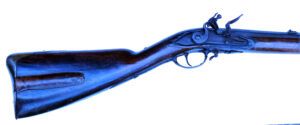
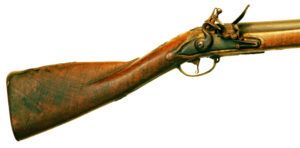
Longrifle made in Augusta County, Virginia 61 -63
This ca. 1750 flintlock longrifle is attributed to the Augusta County School of longrifle makers. It is very possible that it was made by John Hannah. John was among the earliest gunsmiths known to have worked in Augusta County, Virginia. Prior to 1739, the Hannah family settled in Augusta County on land southwest of Staunton, Virginia on Colliers Creek. Colliers Creek lies southwest of Lexington, VA in Rockbridge County. They settled on land acquired from Benjamin Borden who had been the recipient of the Borden Land Grant in 1738.
In 1754, John Hannah agreed to teach his indentured servant, John Mitchell, the art of a blacksmith and gunsmith. In 1768, John built a mill on Colliers Creek. Based on his inventory of tools recorded after his death in 1782, he was a blacksmith, white-smith, silversmith, and gunsmith.
The Shaffer (Schaffer, Sheffer) Family of gunsmith moved from Shenandoah County, Virginia to the Mount Solon area. While Jacob Schaffer and Daniel Schaffer were identified as gunsmiths working in Augusta County in the 18th century, only a longrifle barrel signed in a silver plate by Jacob has been found. Perhaps the most prolific Shaffer Family gunsmith was William Shaffer of Mount Solon, Virginia. More than a dozen excellent longrifles made by William are in private collections along with the tools from the shop that he shared with his son Wetzel Sheffer who was also a gunsmith. A very unusual firearm made by William is known as the Virginia Pacificator that is in the collection of the Virginia Historical Society in Richmond, Virginia. William made this revolving firearm just prior to the Civil War. Lorenzo Sibert received the United States Patent for the design of the Virginia Pacificator. Because of its important revolving mechanism that would fire multiple rounds of ammunition this firearm would likely have gone into production had it not been for Virginia’s decision to join the Confederate States of America which prevent the firearms from being tested by the United States government.
During the 18th and 19th century there were numerous gunsmith that worked in Augusta County and then followed the settlement of the frontier into the Wilderness District and the Western District of Augusta County. Longrifles made by gunsmiths such as John Davidson, Thomas Simpson, John Sheets, Henry Sheets, John Clemmer, Williams Wells, William Reynolds, James McCamant, William McCamant, John Painter. Alexander McGilvay, John Wilson, William Site, John Sites, George Sites, George Peterman, Adam Evick, John Beaton, William Shaffer, and Wetzel Shaffer are encounters.
John and son Henry Sheets operated a longrifle shop in Staunton, Virginia from 1798 to 1832. Their longrifles were among the finest longrifles ever created. This father and son gunsmith’s art and attention to detail is found on all of their work. The design, engraved brass hardware, silver inlay and unique set triggers found on their American longrifles are among the best work ever found. Capt. Isaac Frame, during the War of 1812, writes to the James Barbour, Governor of Virginia: “John Sheets of Staunton, VA is as grand a genius as the world affords”. (From research by Wallace Gusler, Williamsburg, Virginia.)
John Clemmer apprenticed to John and Henry Sheets to learn the trade of gunsmithing. He made longrifles in Staunton while working in the Sheets Shop and after his apprenticeship in the Lexington, Virginia area.
During the 20th century there have been longrifles made in Augusta County by Herman Reed, Harold Kivlighan, Wallace Gusler, Don Greene and perhaps other.
Militia Rangers
Preparing to survive a Native American raid was a matter of staying alive on the frontier. Individual survival often depended upon that preparation, but even more important was early warning from other settlers of a forth coming activity by Native Americans that were most often hostle. Another challenge to peaceful settlement in the Augusta County frontier was the French Army that claimed much of the land in the Western District of Augusta County.
On May 28th, 1755, the Council adopted an act to protect the region from insult and encroachment:
On July 4th, 1754, Colonel George Washington with soldiers from the Augusta Country Militia, battled the French Army at Great Meadows just east of the confluence of the Ohio River. Virginia was defeated. This defeat raised serious questions about the future of the ownership and settlement of the Western Virginia.
District of Augusta County. Fear of the French and the Native Americans was high. Lt. Governor Dinwiddie wrote:
- “The men selected to make up the Augusta Ranger Company were not ordinary farmers that became militiamen; they were young frontiersmen and were usually active in the Augusta County Militia.”
They were hardy backwoodsmen, hunters, trappers, and were often experienced in fighting Native Americans. They did participate in family farming and thus appeared as ordinary men roaming the frontier. The original company of fifty rangers expanded by recruiting other settlers, traders, and even Native Americans to assist them in guarding the Augusta Frontier.
It was their total independence, courage, understanding of the forest, unconventional tactics, and skilled marksmanship that made them invaluable in carrying out their mission on the Augusta County Frontier, and the waging of war against the Frenc
Forts
By 1755, more than 1,000 families had settled in Augusta County. The Ohio Company and the Loyal Company were recruiting additional families to the Augusta County Frontier. Augusta County was an important investment for many influential Virginians and settlers. Dozens of safe houses and forts were built along the frontier. (see Military – Forts of Augusta County for additional information)
Page developed by Gordon Barlow gordon@amaty.com