






Industry Preface
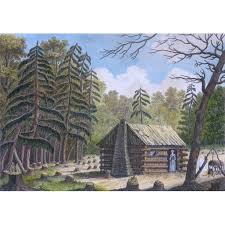
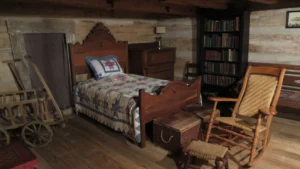
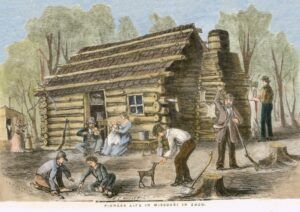
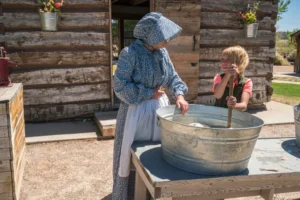
During the early 18th century, Augusta County saw a migration of primarily Scotch-Irish, Irish, German people, other English people from eastern Virginia would brought with a small group of black people, who had found their way to American. They were, by necessity, a hardworking, fearless people that were skilled in agriculture and other skills such as carpenters, blacksmiths, textile makers, gunsmiths and other skills need for frontier survival. These talented and innovative settlers were the founders of industry in Augusta County that would grow into a defined economy over centuries to come.
These resourceful settlers grew wheat, rye, corn, oats, flax, barley, hemp and tobacco. They raised cattle, horses, mules, goats, chickens, turkeys and hogs. These products feed their families and neighbors and soon became money crops from export. These raw materials also lead to the development of textiles such as feed bags, rope, linen, flour, corn meal and whiskey and were combined with grain and livestock to become exports to Maryland, Pennsylvania, New Jersey and eastern Virginia.
By the mid-18th century, Staunton had developed as the commercial trading center west of the Blue Ridge Mountains in Augusta County, Settlers became entrepreneurs and tradesmen arrived with their families. So was the beginning of family owned industry in Augusta County during the last half of the 18th century.
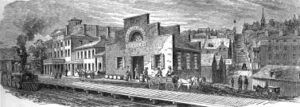
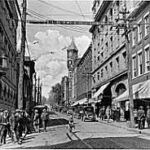
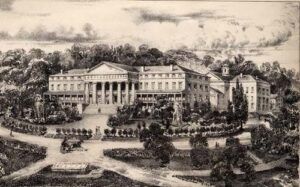
Industry in Augusta County began to mature in the early 19th century. Wooden commercial buildings were replaced by building of stone and brick construction with outstanding architecture. By 1850 Augusta County and especially Staunton and other small communities in the county saw its own industrial revolution with factories making textiles, carriages, boots, shoes, clothing guns, blankets, blacksmith products, farm equipment saddles, milled lumber and more. The Wharf Area in Staunton was developed with warehousing and commercial businesses. Staunton had commissioned merchants that brokered products to markets such as Washington, Baltimore and Philadelphia. Wild game was a favorite product of the commissioned merchants. Commercial ventures such as wholesale grocers, hardware stores, clothing stores, saloons, distilleries, liveries, restaurants and hotels flourished as Staunton became a trade center and a Chesapeake and Ohio railway station stopping point for travelers between Washington and Cincinnati. Waynesboro moved from a crossroad to a developing town and also saw growth and industrial development.
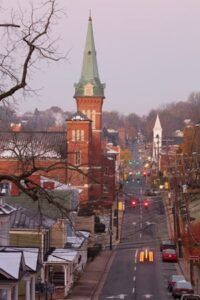
The 20th century continued with the growth experienced in Augusta County, Staunton and Waynesboro during the 19th century. The availability of land, roads and railways coupled with availability of quality workers and the attractiveness of community life and great schools and health care attracted large industry. Industry in Augusta County, Staunton and Waynesboro saw great expansion during the 20th century.
The 21st century is experiencing exciting new growth.