
The 19th Century in Augusta County
The Revolutionary War in America was over. American was the victor and had defined itself as a nation. America’s economic loomed in the balance as trade with Europe and other nations was in a turmoil. Times were difficult but Augusta County fared very well with agriculture and cattle provide a sound bases on which the Augusta County economy was built. Regardless, England had become a powerful nation and was establishing colonies throughout the world including the Caribbean Islands. America had humiliated England during the American Revolutionary War and they had not forgot how they lost an important colony.
Augusta County 1800 – 1825
By the early 19th century, the county became an important producer of wheat, making milling, and distilling significant aspects of the local economy. Cyrus McCormick, invented the reaper, which revolutionized agriculture around the world, at his family’s farm, “Walnut Grove” at Steele’s Tavern in southern Augusta County on the Rockbridge line.
War of 1812 and Augusta County
England could not resist the opportunity to try to reclaim America and thus they launched an offensive against America know as the War of 1812. (see Military – War of 1812 for more information)
A Quiet Prosperity in Augusta County (1825 – 1854)
The county was an important early transportation center, with the Valley Turnpike, originally the Warriors Path, the Great Wagon Road coming through it north-south, and the Parkersburg Turnpike linking the area to the Ohio River. In 1854, the Virginia Central Railroad reached Staunton, providing access to Richmond, the capital, for goods and passengers. This rail link made Staunton significant to the Confederacy during the Civil War as a supply center, especially for agricultural products of the prosperous county farms.
Augusta County has long been a center of education. Among schools that have flourished here for more than a century have been the Virginia School for the Deaf and Blind, Augusta Female Seminary (now Mary Baldwin College), Virginia Female Institute (now Stuart Hall School) in Staunton and Fishburne Military School in Waynesboro. Earlier schools included Mossy Creek Academy run by Jed Hotchkiss, who became General T.J. “Stonewall” Jackson’s mapmaker, Augusta Military Academy in Ft. Defiance, Staunton Military Academy in Staunton, and Fairfax Hall in Waynesboro. Roanoke College and Washington and Lee University had their starts in Augusta County.
The choice of Staunton for the new lunatic asylum did not seem especially significant in 1825. Over the next quarter of the nineteenth century, however, several additional institutions and schools were established in the community, not only stimulating the town’s economy but also determining the direction of its growth. As the earliest of these institutions, Western Lunatic Asylum holds a special place in Staunton’s history. Virginia had pioneered the movement for care of the insane in 1773 when the first publicly supported mental hospital in the New World was founded in Williamsburg. When Western Lunatic Asylum opened in Staunton in 1828, it was one of only five such facilities in the entire United States. Architect William Small of Baltimore was commissioned to design the first hospital building, and to day this handsome structure ranks as one of the finest regional examples of early nineteenth century institutional architecture. Despite the elegant appearance of the facility, the first patients endured conditions little better than those found in prisons. In 1836 the hospital’s “Keeper,” Samuel Woodward, was replaced by Dr. Francis Taliaferro Stribling, who served first as visiting physician and later as superintendent. This remarkable man spent his lifetime instituting reforms at the asylum that made it for its time a model of enlightened care for the mentally afflicted.
With the coming of the asylum, Staunton entered a new phase of growth. An 1833 account describes the town as
. . . the seat of justice for Augusta County . . . the residence of several distinguished lawyers and physicians . . . the site of a lunatic hospital of great reputation …. It has several beautiful edifices erected for public worship, and fifteen or twenty retail stores, with four or five taverns kept in good style. lt is surrounded by many valuable farms, and a considerable number of elegant brick dwelling houses, has several turnpike roads . . . from which it derives great advantages, and of course, is a place of extensive business …. Its central situation, the fine health of the country, its contiguity to the numerous mineral springs, its safety from danger of invasion . . . present most cogent arguments in its favor. While Staunton undoubtedly had its particular advantages, the town’s development was greatly assisted by the effects of two nationwide movements: the tremendous improvement in all forms of travel and transportation and a general “democratic” trend that was best manifested in the election of President Andrew Jackson in 1828.
Travel for most Americans became swifter, safer, and more convenient after 1825. New roads and canals were built, existing roads were graded and paved, and the rail-roads began to build the transportation network that shaped the country’s future. In the Valley several important roads were built, “giving considerable impetus to Staunton.” Many of Virginia’s early roads were funded through turnpike companies which were chartered by the legislature and authorized to issue stock to cover construction costs. The state purchased a portion of the stock (usually three-fifths) and the locality was responsible for raising the remaining funds through private stock sales. Construction of the Valley Turnpike in the late 1830s was the road-building project that most affected Staunton. The macadamized turnpike ran between Winchester and Staunton, a distance of about ninety-five miles. For much of its length, it followed the old Wagon Road, which, in turn, had followed the Warriors’ Path of the Iroquois. Today this road is U.S. Route 11.
The other national trend that influenced Staunton had its roots in the humanitarian causes that swept the country after the presidential election of 1828. While some of these popular causes, such as temperance and labor reform, did not seriously affect this area during the 1830s and 1840s, that of education made a deep impression that has lasted to this day. Indeed, Staunton was destined to become renowned for educating two groups that had been left out of the traditional academic process-the handicapped and women.
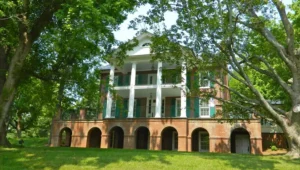
Efforts to establish a school for the deaf in Virginia had begun as early as 1825, followed by a movement to create a similar institution for the blind. Finally in March of 1838, the General Assembly passed an act establishing The Virginia Institution for the Deaf and Dumb and Blind. Many sites were proposed for the facility, but the choices eventually narrowed to Richmond and Staunton. The House selected the latter by a vote of 65 to 49. James Bell of Staunton offered to donate a five-acre tract a quarter-mile east of town as a building site, and the institution’s Board of Visitors eagerly accepted his offer. Baltimore architect Robert Cary Long, Jr. was commissioned to design the main building. The choice was a fortunate one. For the modest sum of $250, Long produced a magnificent Greek Revival design, which is as impressive today as when it was completed in 1846.
The years of Jacksonian Democracy also fomented an interest in higher education for women. Girls schools were not uncommon before this, but they tended to be finishing schools that provided their students with little intellectual stimulation. The three prominent female seminaries founded in Staunton in the mid-1840s all had curricula designed to challenge the minds of bright young women. Each school was associated with a major denomination-Presbyterian, Episcopal, and Methodist.
The earliest of the three was Augusta Female Seminary, founded in 1842 by the Reverend Rufus W. Bailey. Bailey was a career educator who had moved to South Carolina from his native New England in 1827. He eventually relocated in Virginia and appears to have come to Staunton with the specific intent of starting a school for girls. Shortly after his arrival, he met with community leaders to suggest establishing a seminary “of high grade for the education of girls and young women, distinctively under Presbyterian control.” His suggestion was accepted, and in August of 1842 Augusta Female Seminary was founded. Almost immediately Bailey began negotiations with Staunton’s Presbyterians to use the vacant lot next to their church as a site for the new school. The congregation agreed and the cornerstone for the building was laid on June 15, 1844. Until the school building was ready, classes were held in the Craig residence on Greenville Avenue.
The second school, Virginia Female Institute, was established on New Year’s Day of 1844. It was actually a step- child of a school begun thirteen years earlier by Maria Sheffey, widow of prominent lawyer and politician Daniel Sheffey. When he died in 1830, Sheffey had bequeathed his spacious home Kalorama to his wife. The industrious Mrs. Sheffey and her daughters opened a school for girls at Kalorama the following year. At this time Staunton abounded with private elementary schools for both boys and girls. There were also a number of classical high schools for boys, but Mrs. Sheffey’s school was the first to offer girls instruction past the elementary level.
The Virginia Female Institute was created by combining Mrs. Sheffey’s school with a new seminary associated with the Episcopal Church. Mrs. Sheffey and the Reverend James McElroy were elected joint principals and the seminary was scheduled to open for the fall session at Kalorama. After only one year, however, it became clear that the arrangement would not work, and the Trustees of Virginia Female Institute contracted with architect Edwin Taylor for a new building on Frederick Street. The corner- stone was laid in the spring of 1846, and by December the building known as Old Main was ready for occupancy.
Early in 1846, a local newspaper announced that the Methodists planned to start a seminary. The Wesleyan Female Institute officially opened in September of 1846 with thirty day-students and a handful of boarders. The Reverend J.R. Finch served as the principal. At first classes were held in the basement of the Methodist Church, but soon sessions moved to the Chandler Building on Beverley Street. Anxious to have their own school building, the Board secured a site on the north side of West Beverley Street adjacent to the Methodist Church. Captain John F. Smith served as architect, and members of the Masonic lodge laid the cornerstone. This building housed the Wesleyan Female Institute from 1850 until 1870, when the school moved to Madison Place.
In addition to the proliferation of educational facilities in Staunton, a number of internal improvements contributed to the town’s quiet but steady progress during the 1830s and 1840s. Advances in the nation’s transportation system heralded the beginning of a new era of comfort for the traveler as large hotels replaced the rustic inns and taverns of colonial times. Staunton’s first hotel, the Virginia, was built in the 1840s. An impressive brick structure, it occupied the South New Street site of the former Washington Tavern that dated back to revolutionary days. It was said that the register of the Washington held such famous names as Clay, Jefferson, Madison, and Fillmore.
Staunton’s first bank opened for business in 1847. Called the Valley Bank at Staunton, it was a branch of Winchester’s Bank of the Valley in Virginia. lt served as the town’s only bank until after the Civil War.
A municipal cemetery was begun in 1849 in response to severe overcrowding in the graveyard of Trinity Episcopal Church (formerly Augusta Parish Church). The twelve acres west of town purchased by the Thornrose Cemetery Company became the nucleus for one of Virginia’s most beautiful burial grounds.
Improvements in the water system also took place during this era. As historian Joseph Waddell points out, “the labor of carrying water to distant points no doubt retarded the growth of the town. There were few houses on the hills.” In 1839 running water was being pumped to the Western Lunatic Asylum, but the supply proved inadequate for the rest of town. Finally in 1848 water from Buttermilk Springs in Augusta County was successfully piped into Staunton. Waddell states, “Dwellings soon sprang up on the hills surrounding the town.”
Largely due to the hilly terrain and the lack of water, residential development during Staunton’s first century had been limited to those areas immediately adjacent to Oldtown. As the roads improved and fresh water became available, however, the townspeople began to build homes in suburban neighborhoods. The Gospel Hill area was developed in the mid-1840s after the Winchester Road (now Coalter Street) was paved and Beverley Street extended to the new school for the deaf and blind. The first homes to be constructed around Gospel Hill were substantial, reflecting the wealth and solid social standing of their owners. Similar growth occurred in Newtown and the Stuart Addition, especially near the grounds of the new women’s seminaries.
By far the most popular architectural style during this period was the Greek Revival. The youthful American republic was perceived as the logical successor to ancient Greece with its democratic ideals. Hundreds of towns east of the Mississippi were given Hellenic names such as Sparta, Ithaca, and Athens, and the Greek temple form became the preferred mode of architectural expression for schools, churches, banks, and public buildings. Architectural pattern books, appearing in the late 1830s, were read by thousands of homeowners and led to a wide dispersal of the style. By the mid-1840s, dwellings in the Greek Revival style had become commonplace.
The main buildings of the Institution for the Deaf and Blind, Augusta Female Seminary, and the Virginia Female Institute were all Greek Revival designs. All had heavy cornices, symmetrical facades, and impressive columned porticoes typical of the style. Many of the homes built in the new neighborhoods also used Greek Revival motifs in simplified versions interpreted by local builders.
The Augusta County Courthouse, seemingly an accurate barometer of changing public tastes, also underwent a transformation during this era. The 1789 courthouse, described by Waddell as “an unsightly stone structure, nearly square, and two stories high,” was replaced in 1835-36 by a “brick house with wings for clerks’ offices, etc., and stately columns in front, but not architecturally correct.” This courthouse, the county’s fourth, was built in the Greek Revival style and stood until 1900.
In Staunton, as elsewhere in America, the second quarter of the nineteenth century was characterized by the vigor and confidence inspired by the successful experiment in democracy, steady economic growth, widespread humanitarian awakening, a youthful population moving westward, and a greatly improved transportation system. When the Virginia Central Railroad was completed as far as Staunton in 1854, the little Valley town became one cog in the vast network of the continent’s railways. Strangely enough, this event, which seems monumental in its historical implications, is given only a passing announcement in the local paper. The following item appears on page two of the Staunton Spectator and General Advertiser of February 15, 1854:
The work on the Virginia Central Railroad at this place is rapidly progressing to completion. The track is laid nearly up to the Passenger Depot, and in two or three weeks at farthest everything will be ready for the cars.
Mexican War and Augusta County
While the Mexican War did not take place on Augusta County soil, the frontiersmen of Augusta County participated in the war. (See Military – Mexican War for more information)
Disorder in the Town, (1854 – 1870)
Thus from a state of perfect tranquility, the country passed into one of war, and the whole land resounded with the noise of armaments, and the treasure of the people was exhausted in vast preparations for hostilities.
As far back as the 1760s George Washington had seen the need to link the region west of the Alleghenies to the eastern seaboard through a system of roads and canals. Many years later this network became a reality with the James River and Kanawha Canal, which served as “Virginia’s principal artery of traffic for both freight and passengers in the antebellum era.” Even as the canal system approached its heyday, however, it was doomed to extinction by the appearance of a vastly superior mode of transportation-the railroads.
Staunton’s earliest railroad grew out of the Louisa Railroad Company, chartered in 1836. It operated successfully between Hanover and Louisa counties until 1850, when the tracks were extended westward to Charlottesville. In keeping with its new expanded image, the line was re-christened the Virginia Central Railroad. By 1854 the Virginia Central had crossed the Blue Ridge to Staunton, and six years later it ran from Richmond to its western terminus near Covington. Because of its strategic route between the Shenandoah Valley and the state capital, the Virginia Central was destined to play a leading role in the Civil War. Before that conflict began, however, this railway provided a considerable boost to the economic vitality of the counties it served.
The railroad reached Staunton in March of 1854, but the service in its first few months of operation appears to have been somewhat erratic. The proprietors of the Virginia Central, however, showed their complete faith in the success of their endeavor by erecting an elegant hotel across from the passenger station. The Spectator of June 14, 1854, announced, “We understand that the new Hotel, which is now nearly complete, is to be called the ‘American.'” Like the Virginia Hotel before it, the American was of Greek Revival design-one of the last buildings in Staunton to utilize this austere architectural style.
The popularity of the Greek Revival declined sharply after 1850, as it was supplanted by more exotic and picturesque architectural styles from Europe. In 1855, less than a year after the completion of the American Hotel, Staunton’s Episcopalians erected their third church, using the new Gothic Revival style. Based on English parish churches of the Middle Ages, the Gothic Revival soon became widely used for ecclesiastical and institutional structures all over America. Trinity Church is one of Staunton’s earliest buildings in this style.
The other romantic building style that appeared during the 1850s was the Italianate. Based on the villas of northern Italy’s countryside, this derivative style influenced American architecture until the end of the century. Although isolated examples of both Gothic Revival and Italianate buildings from the antebellum period do exist in Staunton, most of the buildings erected in these romantic or revival styles were built after 1870, when the years of war and reconstruction were over.
On the eve of the Civil War Staunton was the largest town in the upper Valley, with a population of 4,000, three banks, eighty businesses, and over four hundred dwellings. It was served by an excellent transportation network, including a major railroad running directly to the state capital, five stagecoach lines that radiated out from the town to connect with other important rail systems, and many fine roads-among them the Valley Turnpike to Winchester. Staunton was home to a number of vital industries, including many grist and saw mills, and factories that made wagons, boots, shoes, woolen clothing, and blankets. In the late 1850s a magnetic telegraph line to Richmond was installed and gas lines were laid, providing modern illumination for the town’s streets and homes.
Soon the Civil War would dominate life in Augusta County. People would have to choose to side with the Union or the newly formed Confederate States of America. (See Military – Civil War)
The reconstruction period that followed was not as bitterly humiliating for this area as it was for other parts of the South. Virginia’s western counties generally were less dependent on slave labor for their agricultural production and had more diversified economies. Also, compared to cities such as Richmond and Fredericksburg, Staunton had economies. Also, compared to cities such as Richmond and Fredericksburg, Staunton had suffered little physical damage. Widespread hunger and a severe shortage of hard currency did exist, but at the same time an urgent spirit prevailed to restore normalcy as soon as possible.
Only months after Lee’s surrender, Staunton’s railroads had been repaired and postal service was restored. General John Echols traveled to Baltimore seeking capital to start a new bank to replace the banks that had failed during the war. Staunton’s private schools resumed operations. The deaf and blind students returned to their facility and the Virginia Female Institute started up sessions once again. The Augusta Female Seminary, which had barely remained open during the war, was about to embark upon a period of unprecedented growth under the direction of a former student. When Mary Julia Baldwin was engaged as the seminary’s principal in 1863, no one could have foreseen the devotion with which she would pursue her task.
In November of 1865, civil authority was nominally restored and representatives were elected to the state legislature. The last Federal troops left Staunton on January 12, 1866, and Waddell wrote in his diary, “They were accused of exciting much disorder in the town and their departure caused general rejoicing in the community.”
Thousands of freed blacks moved during Reconstruction, seeking employment and a better life. A sizeable migration of former slaves moved west from the eastern parts of the state. They came to towns such as Staunton because of the higher wages and the somewhat more tolerant surroundings in which to begin a new life. Lacking any schooling or job skills, many started out as laborers or domestic workers. But in Staunton the black population began to progress within a generation with the help of free public schools and strong church ties. Immediately after the war Staunton blacks had organized three churches. Much more than just spiritual havens, the churches provided the principal social outlet for these oppressed people. They also served as the black community’s first schoolrooms. The African Episcopal Church, founded in 1865, was Virginia’s first black church west of the Blue Ridge. Services were held in the basement of the white Lutheran Church until funds were raised to build Allen Chapel on West Beverley Street. funds were raised to build Allen Chapel on West Beverley Street.
Also in 1865, a Methodist Episcopal group began holding weekly meetings in the Hardy Carriage Works building at Beverley and Market streets. Members attending these weekly sessions made ten cent contributions, and soon the congregation purchased a lot on Augusta Street and built their first church. It was often referred to as the “Dime Church.”
Black Baptists lacked a house of worship from 1866 until 1868, during which time they met on Sunday afternoons in the white Baptist Church. In 1868 the black Baptists officially organized; they then rented a log cabin on East Frederick Street for their services. Two years later members of the Mount Zion Baptist Church laid the cornerstone of their first building on Sunnyside Street.
Reconstruction gave rise to municipal school systems throughout the South. Establishing free public education in the southern states was largely the work and vision of one man-George Peabody of Massachusetts. He set up the Peabody Educational Fund “for the intellectual, moral, or industrial education among the young . . . of the Southern and Southwestern states of our Union …. ” Peabody eventually dispensed $3,484,000, founding free public school systems from Virginia to Texas. The man chosen as General Agent of the Peabody Fund was Dr. Barnas Sears, a career educator and Baptist minister. Sears was almost sixty-five in 1867 when he resigned as president of Brown College in Providence and moved to Staunton to administer the fund. From his cottage overlooking the train station, Dr. Sears traveled all over the South for the last thirteen years of his life. The personal charm, Christian dedication, and tireless energy of this northerner did much to help dispel the bitterness of Reconstruction. When he died in 1880, the town council passed a resolution honoring Sears, calling it a “humble tribute to the character of one who was so universally admired for his talents and revered for his piety and virtue.”
The hated years of Reconstruction came to an end on January 24, 1870 when, by an Act of the United States Congress, Virginia was re-admitted to the Union and her male citizens re-enfranchised. At last, Staunton could shake off the yoke of defeat and look forward to better times ahead.
By the close of the 19th century, Augusta County had recovered from the wound of the Civil War. Citizens were united in their effort to build a strong county with a strong government, a fair tax policy that allowed for growth in every effort. In 1790 the Commonwealth of Virginia created a charter to form Bath County, Virginia. Part of the land to form that county came from Augusta County, thus leaving Augusta County with 968 square miles of land making it the second larges county in Virginia second only to Pittsylvania County located in Virginia on the North Carolina border.
At the end of the 19th century the population of Augusta County was 31,986 with 94.8% being White and 5.2% being African American. No other nationalities were recorded. The Augusta County economy was strong, citizens were engaging in business opportunities including expanding agriculture, cattle and forestry. The county was poised for the 20th century!
Other 19th Century Wars Involving Augusta County
(See Military)
- Indian Wars (1865-1895)
- Spanish-American War (1898)
Additional history needs to be developed – Volunteer(s) needed.
Contact Gordon Barlow gordon@amaty.com 540-448-0344