Ohio Company
Even though he was a native of Pennsylvania, Trent understood that this land was claimed by Virginia and was a part of Augusta County, Virginia.
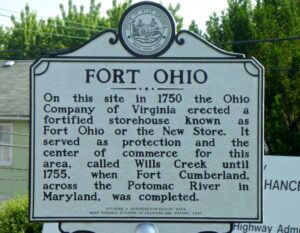
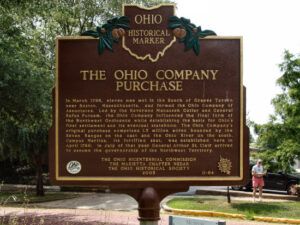
In 1748, after forming the Ohio Company, Lee, L. Washington, A. Washington, and Robert Dinwiddie, Virginia’s Royal Governor (1751 to 1758), invited John Hanbury, Colonel Thomas Cresap, George Mercer, John Mercer, and George Washington to become owners of the Ohio Company. These investors were well-connected to the Crown as Thomas Lee was president of the Virginia Council of State. In 1749, another large tract of land in the Ohio Valley between the Kanawha River and the Monongahela River was granted to the Ohio Company by the British Crown.
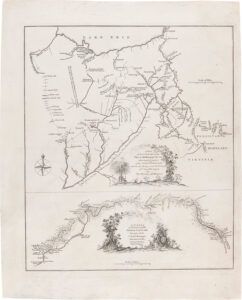
The original land grant was for 200,000 acres. The granting of an additional 300,000 acres was conditional upon the Ohio Company locating 100 families to the tract within seven years, and to also construct a fort along the Ohio River. In addition, the settlers would pay no tax or rent for ten years. The Ohio Company hired several surveyors to survey and record the bounds of their land. Among them were Christopher Gist and George Washington (he and his family members were owners of the Ohio Company).
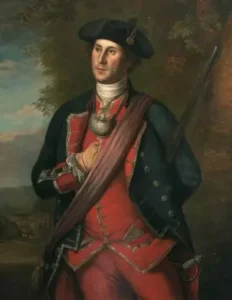
In 1750, Governor Dinwiddie sent George Washington, accompanied by Christopher Gist, to order the French to vacate this land. The order was rejected by the French who also claimed this land.
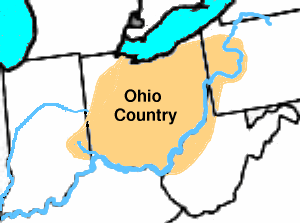
Governor Dinwiddie feared the French presence in the Ohio Country. He turned to William Trent, whom he met because of his land holdings in the Ohio Country, for guidance.
William Trent became an important figure in the history of Western Augusta County. Trent’s relationship with Governor Dinwiddie was so important that Governor Dinwiddie commissioned him to carry out exploration of the Ohio Country for Virginia, and commissioned him as Captain in the Virginia Militia on the western frontier.
Governor Dinwiddie authorized Trent to raise one hundred militiamen for the exploration. He later served with Major George Washington in the French and Indian War. His knowledge of the Ohio region was much greater than that of Washington.
William Trent and George Washington would soon attempt to build a fort at the Forks of the Ohio (present day Pittsburgh). However, they were driven away by the French, who built Fort Duquesne at the same location. These confrontations between Virginia and the French led in part to the French and Indian War that began in 1754. Eventually, Virginia and the other colonies prevailed in driving the French out of Eastern North America.
Virginia signed friendship treaties with the Native Americans beginning in 1752 and purchased the land around the Forks of the Ohio from the Native Americans. The Virginia Militia immediately began to build a fort that became Fort Pitt, and eventually the City of Pittsburgh. Following the Revolutionary War and the completion of the Mason-Dixon Line survey. Pittsburgh and surrounding land was awarded to Pennsylvania and the Virginia Militia vacated Fort Pitt.
Location of Fort Pitt (present day Pittsburgh). This land was purchased from the Native Americans to be a part of Augusta County (deed on file in the Augusta County Court House Deed Book 22 , Pages 1-9 – Dated 1777). Pittsburgh remained a part of Western Augusta County until 1783 when the Mason – Dixon survey defined the land as a part of Pennsylvania and not the Ohio Country.
The Ohio land transitioned through several land companies and was finally settled by The Grand Ohio Company when several competing land companies and individuals coordinated their efforts, and won a petition from the British Crown to develop the Ohio Country. Ohio settlement expanded rapidly.
In 1787, the Northwest Territory was created under the Northwest Ordinance and was approved by the United States Congress. The western border of Augusta County was redefined to exclude the Ohio Country including land to its north and west.
In 1803, Ohio became the 17th State to join the United States of America.
Page developed by Gordon Barlow gordon@amaty.com